As photonics technologies continue to advance, electro-optic modulators have become essential building blocks in applications ranging from quantum technologies and optical sensing to telecommunications and precision metrology. These devices provide precise, high-speed control of light, allowing engineers and researchers to manipulate optical signals with exceptional accuracy and reliability.
To support these evolving requirements, Covesion offer a comprehensive range of electro-optic modulators designed for near-UV, visible, near-infrared and telecom wavelength applications. The portfolio includes phase modulators, amplitude modulators, telecom modulators and custom solutions tailored to the needs of researchers, OEMs and system developers.
What is an electro-optic modulator?
An electro-optic modulator (EOM) is a device that uses an applied electrical signal to alter the properties of light travelling through an electro-optic material. Depending on the application, electro-optic modulators can modify the phase, amplitude power or polarization of light, enabling precise control of light without affecting the stability of the laser source itself.
Covesion modulators do this by taking advantage of the Pockels effect, where the refractive index of a non-linear crystal changes in the presence of an electric field. Our solutions are focused on near UV to visible wavelengths, waveguide-based, fiber-coupled EOMs. Our technologies are based on KTP, LN and MgO: LN non-linear crystals.
What are electro-optic modulators used for?
Electro-optic phase modulators are essential tools in precision photonics, enabling a wide range of applications by imprinting controlled phase variations onto laser fields. In Pound–Drever–Hall (PDH) locking, they generate phase modulation sidebands that allow sensitive error-signal detection for stabilizing laser frequency to high-finesse cavities. In interferometry, phase modulators provide dynamic phase control for fringe stabilization and heterodyne detection, improving sensitivity in systems such as gravitational wave detectors and precision metrology setups. In spectroscopy, phase modulation enables techniques like modulation transfer and frequency modulation spectroscopy, enhancing signal-to-noise ratios and enabling detection of weak absorption features.
For cavity locking and FM mode locking, phase modulators introduce frequency or phase modulation that helps synchronize laser modes with cavity resonances, leading to stable pulse generation in lasers. In atomic, molecular, and optical (AMO) experiments, they are widely used for coherent control, sideband generation for laser cooling and trapping, and precise manipulation of quantum states. Additionally, in serrodyne frequency shifting, a phase modulator driven by a sawtooth waveform enables highly efficient, broadband frequency translation of optical signals without introducing multiple sidebands, making it valuable in coherent communication and advanced laser control systems.
Electro-optic amplitude modulators play a crucial role in shaping and controlling the intensity of light for time-domain photonic applications. In pulse carving, they are used to slice continuous-wave laser output into well-defined optical pulses with precise temporal profiles, which is essential for optical communication and ultrafast experiments. As optical shutters or gates, amplitude modulators provide fast switching of light on nanosecond to sub-nanosecond timescales, enabling controlled transmission or blocking of signals in synchronization with experimental sequences. They are also widely employed in time-bin generation, where controlled pulse sequences create distinct temporal modes used in quantum communication and encoding schemes.
Additionally, in pulse picking applications, amplitude modulators selectively transmit specific pulses from a high-repetition-rate pulse train, effectively reducing repetition rate or isolating individual pulses for amplification or measurement. Overall, their ability to precisely manipulate optical intensity in time makes amplitude modulators indispensable in both classical and quantum photonics systems.
Lithium niobate and KTP modulator technologies
The performance of an electro-optic modulator depends heavily on the material platform used in its construction. Lithium niobate (LN) has long been recognized as one of the industry's leading electro-optic materials, offering excellent modulation efficiency, low optical loss and proven reliability. It remains widely used across telecommunications, sensing and precision measurement applications.
Alongside lithium niobate, potassium titanyl phosphate (KTP) is becoming increasingly important in visible and near-infrared photonics systems. KTP offers attractive electro-optic properties across wavelength ranges that are particularly relevant for emerging quantum technologies and advanced research applications.
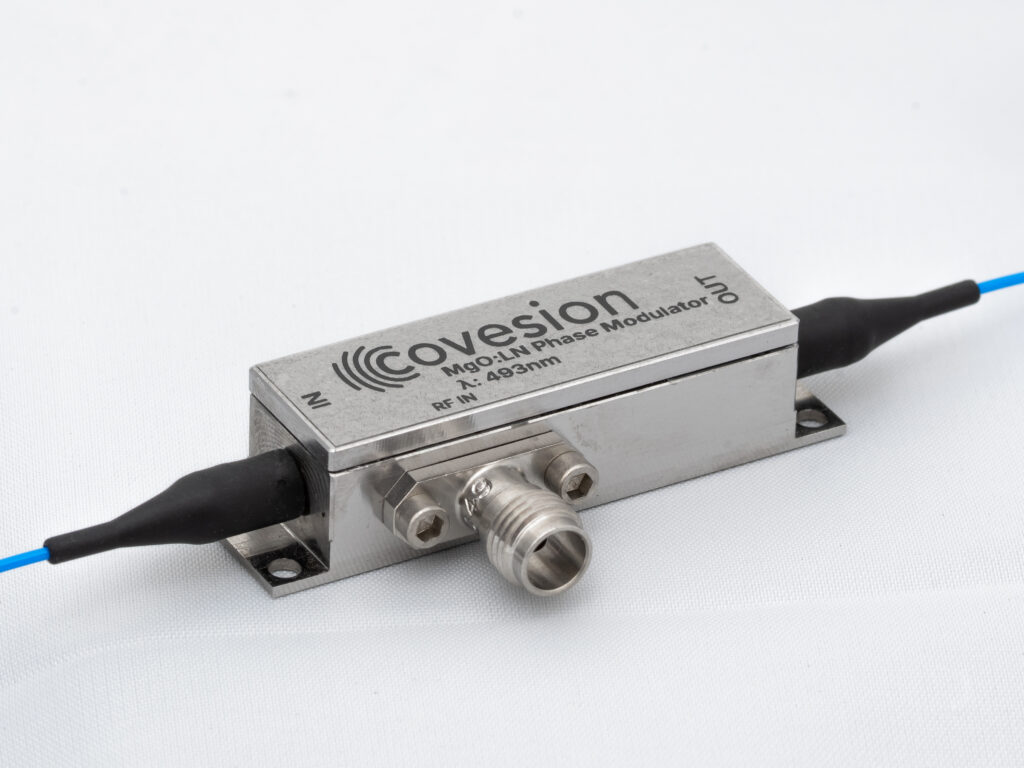
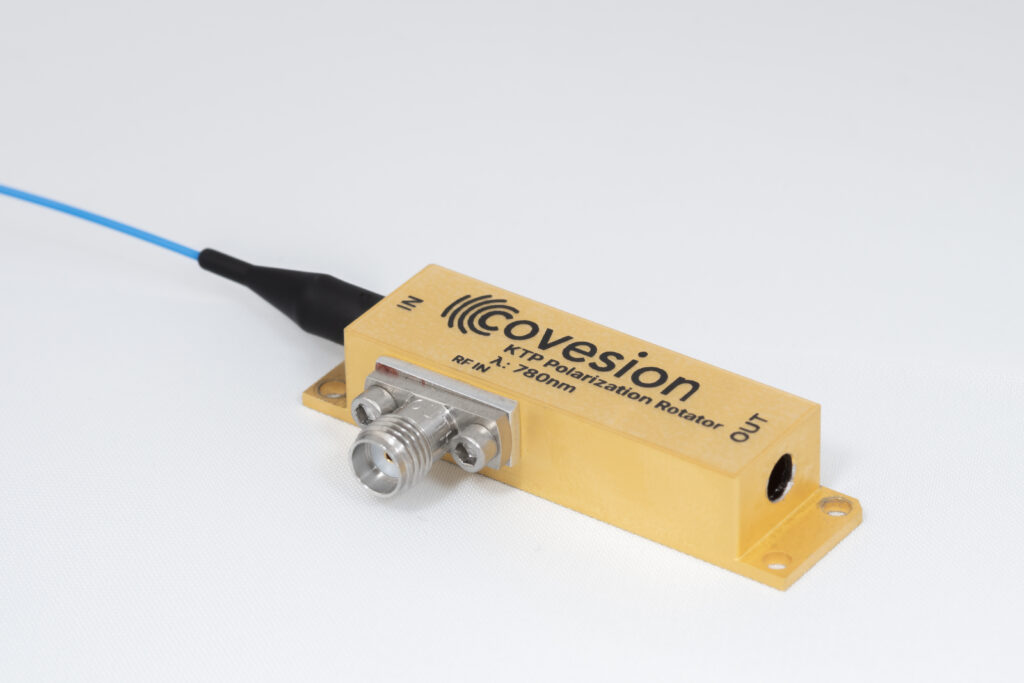
Covesion electro-optic modulator portfolio includes solutions based on LN, MgO:LN and KTP waveguide technologies, providing customers with the flexibility to select the most appropriate platform for their application requirements. Our EOMs have low insertion loss, high power handling and excellent EO performance. Our MgO:LN phase modulators offer low Vπ and high-speed operation in a compact and low insertion loss fiber-coupled configuration, which is available for customer-defined wavelengths ranging from 370nm to 980nm.
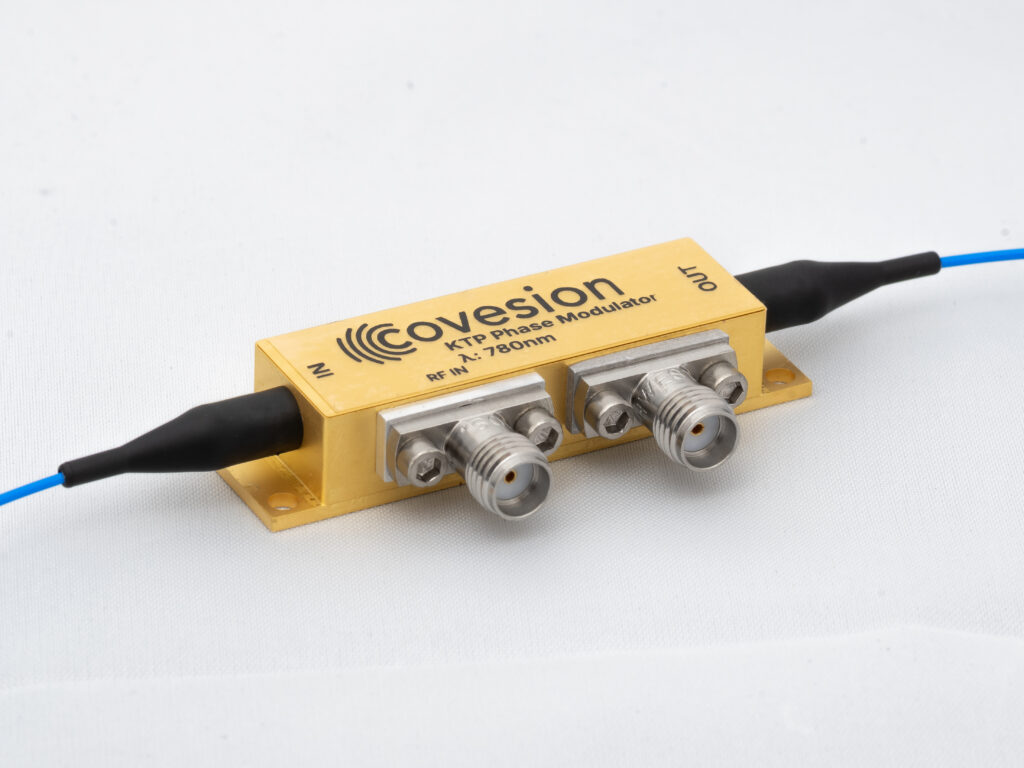
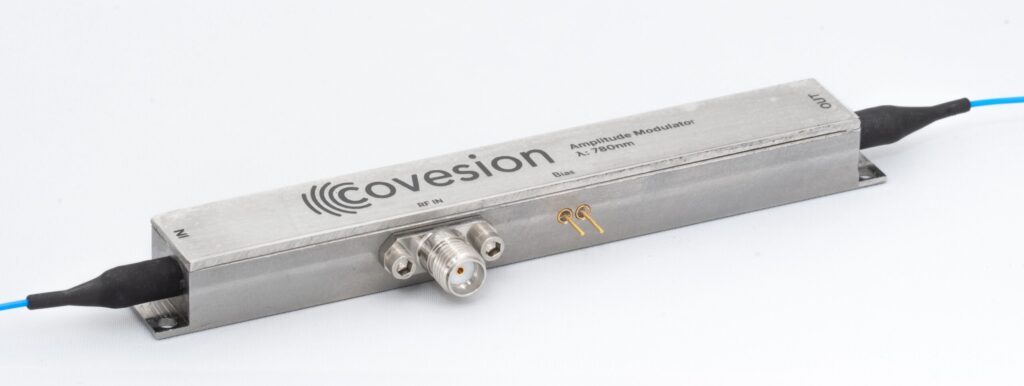
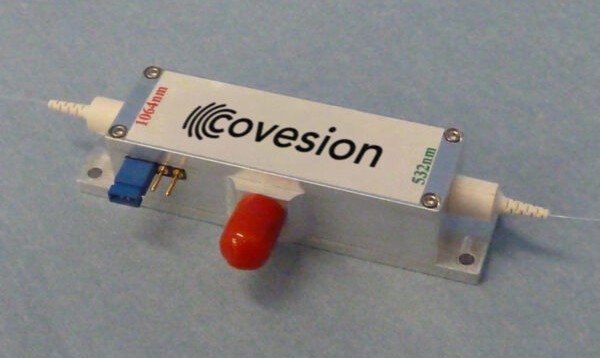
We also offer industry-established phase modulator performance in our line of KTP waveguide-based phase modulators, with available wavelength from near-UV to near-IR. Our LN phase modulator offers a low-loss fiber-coupled device for C-band and O-band operation. Our MgO: LN visible wavelength amplitude modulator is a wavelength-based Mach-Zehnder modulator that provides broadband operation with low Vπ, low optical insertion loss and high-power handling fiber-coupled configuration.
Visible phase modulators for quantum and photonics applications
As quantum technologies move from research laboratories towards commercial deployment, the demand for visible wavelength phase modulators continues to increase. Phase modulators alter the phase of an optical signal while maintaining a constant light intensity, making them essential for applications that rely on precise optical timing and interference effects.
Quantum sensing, quantum computing, frequency comb generation and laser frequency stabilization all depend on accurate phase control. Interferometric measurement systems and advanced spectroscopy applications similarly rely on phase modulation to achieve the levels of precision required for modern photonics research.
Covesion's visible phase modulators have been specifically developed to address these emerging requirements. Available in fiber-coupled configurations using both MgO:LN and KTP waveguide technologies, they provide low Vπ operation, low insertion loss and excellent optical power handling across visible and near-infrared wavelengths.
Visible amplitude modulators for high-speed optical control
While phase modulators control the timing of light waves, amplitude modulators control optical intensity. This enables optical signals to be switched, gated, pulsed or encoded with information, making amplitude modulation a fundamental requirement across many photonics applications.
Our visible amplitude modulators combine low insertion loss, low Vπ operation and high extinction ratios in compact fiber-coupled packages, providing a practical solution for researchers and engineers developing next-generation photonics systems. They are well suited for applications including atomic and ion trapping, quantum optics experiments, precision spectroscopy, and optical pulse generation, as well as other laboratory and OEM systems requiring reliable visible-wavelength amplitude modulation.
Telecom modulators for communications, sensing and metrology
Although much attention is focused on visible wavelength photonics, telecom modulators remain a cornerstone of optical communications and fiber-based sensing systems. Reliable electro-optic modulation at telecom wavelengths continues to underpin applications ranging from high-speed data transmission to precision measurement.
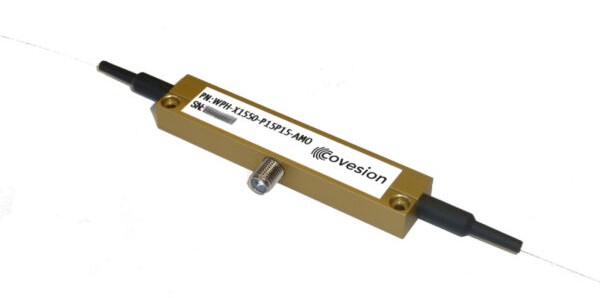
Our telecom modulators are designed to deliver stable, high-performance operation through low insertion loss, minimal residual amplitude modulation and high optical power handling. Built on proven lithium niobate technology, they offer the reliability and performance demanded by modern communications, sensing and metrology applications.
Custom electro-optic modulator solutions
While standard products satisfy many requirements, some applications demand a tailored approach. Whether developing a novel quantum system, integrating photonics into an OEM platform or addressing challenging environmental conditions, system developers often require customized electro-optic modulation solutions.
Our engineers work closely with customers to develop bespoke modulator solutions based on LN, MgO:LN and KTP technologies. By combining expertise in waveguide design, engineering and advanced packaging, we help our customers overcome technical challenges and accelerate the development of innovative photonics products.
Advancing photonics through electro-optic modulation
As photonics continues to transform industries including telecommunications, sensing, scientific instrumentation and quantum technologies, electro-optic modulators will remain a key enabling technology. The ability to precisely control light is fundamental to many of the most exciting developments taking place across the sector today.
Through our range of visible phase modulators, visible amplitude modulators, telecom modulators and custom electro-optic solutions, we are helping researchers, engineers and system developers push the boundaries of what is possible with photonics. Whether enabling the next breakthrough in quantum sensing or supporting high-performance optical communications networks, electro-optic modulation continues to play a vital role in shaping the future of photonics.


